





Christmas Decorations for Home: Ideas and Tips


You come home, look around and realise one simple thing: there is a week left until Christmas Eve, and the only thing standing in the house is the Christmas tree. The rest of the space is quiet, the entrance does not feel festive, and the dining room looks like an ordinary working day. That is exactly why Christmas decorations for the home should be planned not at the last minute, but as a project for the whole home, where each zone has its own role.
If you want Christmas to feel right at home from the first step, you do not need a mountain of things. You need a clear colour scheme, a few strong accents and the discipline to give up anything that only creates noise. This guide is about what to buy, what to leave on the shelf and how to arrange the home so that it looks cohesive rather than overloaded.
Contents
- Why it is worth planning Christmas decorations for the home in advance
- Colour scheme and making a decoration list
- Decorating the entrance area
- Lighting the living room and common areas
- Setting the Christmas Eve and Christmas table
- Saving energy and safety in homes with children
- Shopping list and weekly plan
Why it is worth planning Christmas decorations for the home in advance
If only one thought is circling in your head right now, that you “still need to buy something”, stop. The first step is not a purchase but a plan, because without one it is easy to buy small items that do not match each other. Instead, you get a home where each zone has a clear role and the Christmas look does not scatter.
Cohesion matters more than quantity
Festive lighting and decorations work best at home when they create one clear direction. In Lithuania about 52% of residents decorate not only the tree but the home itself with garlands, and LED light garlands use 80–90% less energy than incandescent alternatives, so it is worth choosing lighting deliberately rather than grabbing the first appealing pack on the day of purchase. More decorations do not necessarily give a better result. It matters more to decide where the main point of light will be, where the texture will be and where a calm background will remain.
Practical rule: if a decoration does not serve a clear function, it usually just takes up space.
Early planning also helps mentally. When colours, zones and the shopping list are already in your head or on paper, you do not need to scroll through the same catalogues every evening and buy whatever “might come in handy”. The home looks tidier, and you avoid the last-week rush, which usually spoils the budget more than any single expensive decoration. This approach is especially useful if you want to keep the number of items small and see a deliberately composed festive environment rather than a pile of trinkets. A useful starting point for this is the Festive.lt guide to the benefits of holiday decorations, where it is easier to put together holiday accessories according to the overall direction of the home.
What to decide before buying
The first question must be very specific: what mood do you want to see every day? Is it a warm traditional look, a calmer Scandinavian setting or a modern light interior? The answer determines the garlands, the tablecloth, the candles and even the balloons, if you plan them for a children’s evening.
Purchases must follow the zone plan, not an impulsive urge. For the entrance choose one brighter accent, for the living room a light layer and a few textures, and for the dining table details that go with the dishes and napkins. This way Christmas decorations for the home become a clear system, not a random set of items that you then have to hide in cupboards.
Colour scheme and making a decoration list
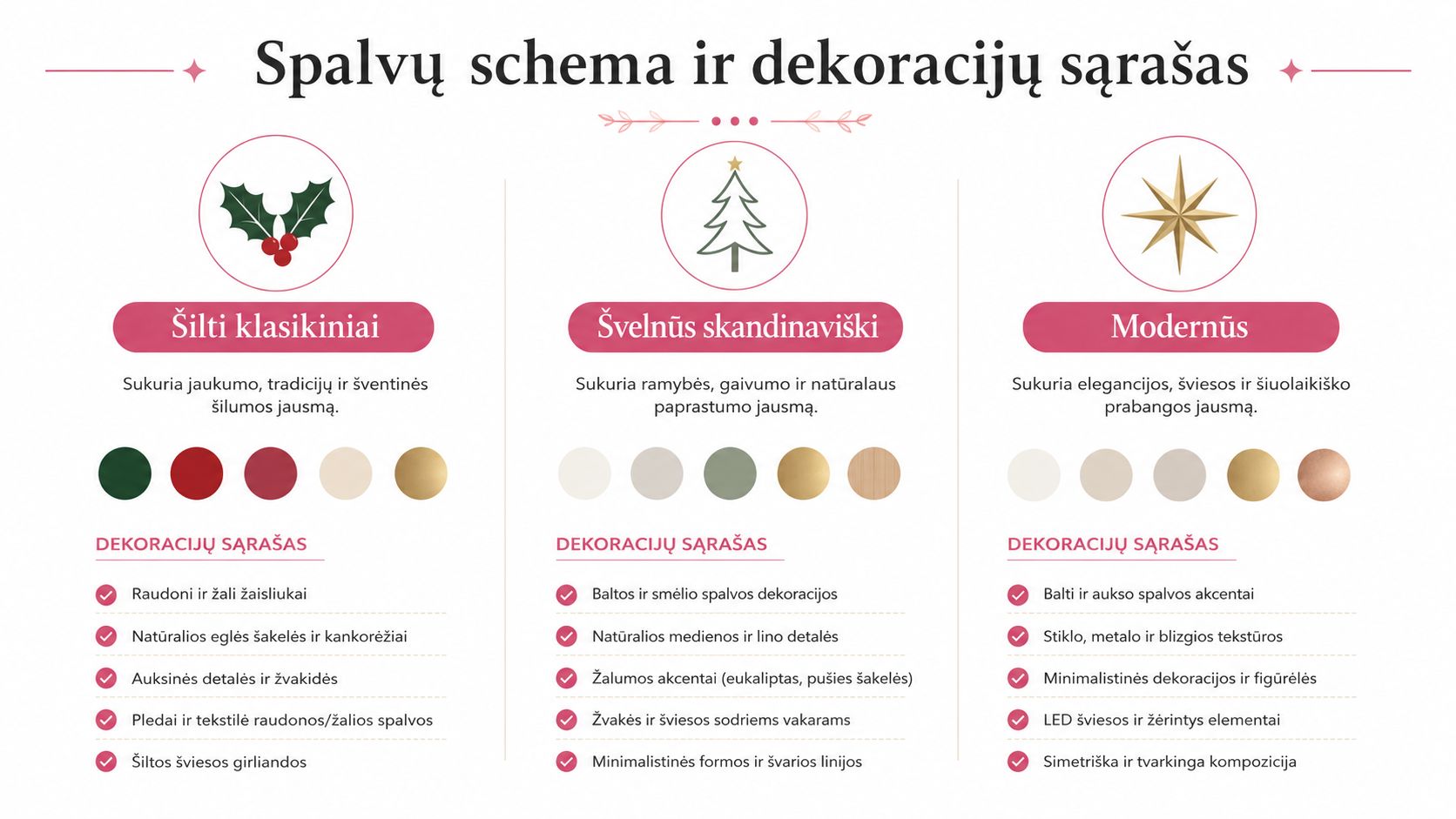
First decide on 2 main colours and 1 accent tone. This is a filter that saves more time than any long browsing. When the palette is clear, each item bought later either fits into it or is rejected without regret.
Three directions worth taking
Warm classic combinations, red with green, suit those who want a clearly recognisable Christmas mood. This scheme looks good when the home already has wood, natural surfaces or darker furniture. If you want warmth without doubt, this is the safest route.
Soft Scandinavian combinations, white with brass, suit an interior that is already calm. Then the decorations do not need to overpower the space; they only highlight the light and the materials. This direction is especially good in smaller flats, where excessive shine quickly becomes tiring.
Modern combinations, white with gold, work when you want a tidy, clean look. They allow you to use fewer items, because the colour itself already creates a festive impression. This scheme suits especially well if you plan more light and fewer figurative elements.
How to turn a colour into a shopping list
Once the palette is chosen, write everything down by zone, not by shop category. The entrance, the living room and the table need different things, but everything must be part of one scheme. This way you will see at once where you need lanterns, where garlands, where a tablecloth, and where a single accent is entirely enough.
The most practical method is layered: first choose the colours, then add natural elements, and only after that introduce the light sources or more striking details. Use the same principle yourself. If you place the lights first, it becomes very easy later to add too many different accents and spoil the cohesion.
Quick check before shopping: colours, zones, background lighting, one accent, and only then the small extra items.
Decorating the entrance area
The entrance has to say everything in a few seconds. If the door and the hallway look empty, the festive feeling arrives disproportionately slowly, even if several garlands are already shining inside. That is why it is worth working precisely here rather than broadly: a wreath, soft lighting and one visible accent go much further than five average items.
What to hang on the door and where to leave space
A door wreath is the main symbol of the entrance. It must match your chosen palette, not simply “be Christmassy”. If the scheme is soft, choose a more natural wreath; if modern, clean lines and fewer small details will suit.
Next to the wreath, a window or railing garland works very well, especially when it is used as a background layer of light. Christmas decorations for the home now include not only the tree, but also windowsills, candles, LED bubbles, lights of various shapes, light bulb compositions and hanging stars. In my view, this is exactly where it is worth being practical, choosing one or two directions rather than trying to hang everything at once.
Small spaces need hanging solutions
If you have a flat vestibule or a narrow hallway, do not place anything on the floor that will get in the way of moving. Hanging elements, stars, small compositions and thin wreaths work better here than bulky table solutions. In a small space each additional object has to be light, not create visual tension and not block the passage.
Plan the entrance decoration as separate “zones”, because the door, the path and the windowsill should not compete with one another. If you have a balcony or railings, fix the garland so that it follows the edges rather than hanging loose. The fixing must be neat, because a crooked garland immediately looks cheaper.
What to choose for a longer season
For the entrance zone choose decorations that will suit not only 24 December but also the January weeks that follow. A sturdy wreath, an LED garland and one subtle light element usually keep their shape longer than very specific, cheerful or noisy solutions. This logic avoids the situation where decorations become boring after just a few days.
Do not buy items for the entrance that only look good on the shop shelf. The entrance has to withstand movement, weather and everyday use.
Lighting the living room and common areas
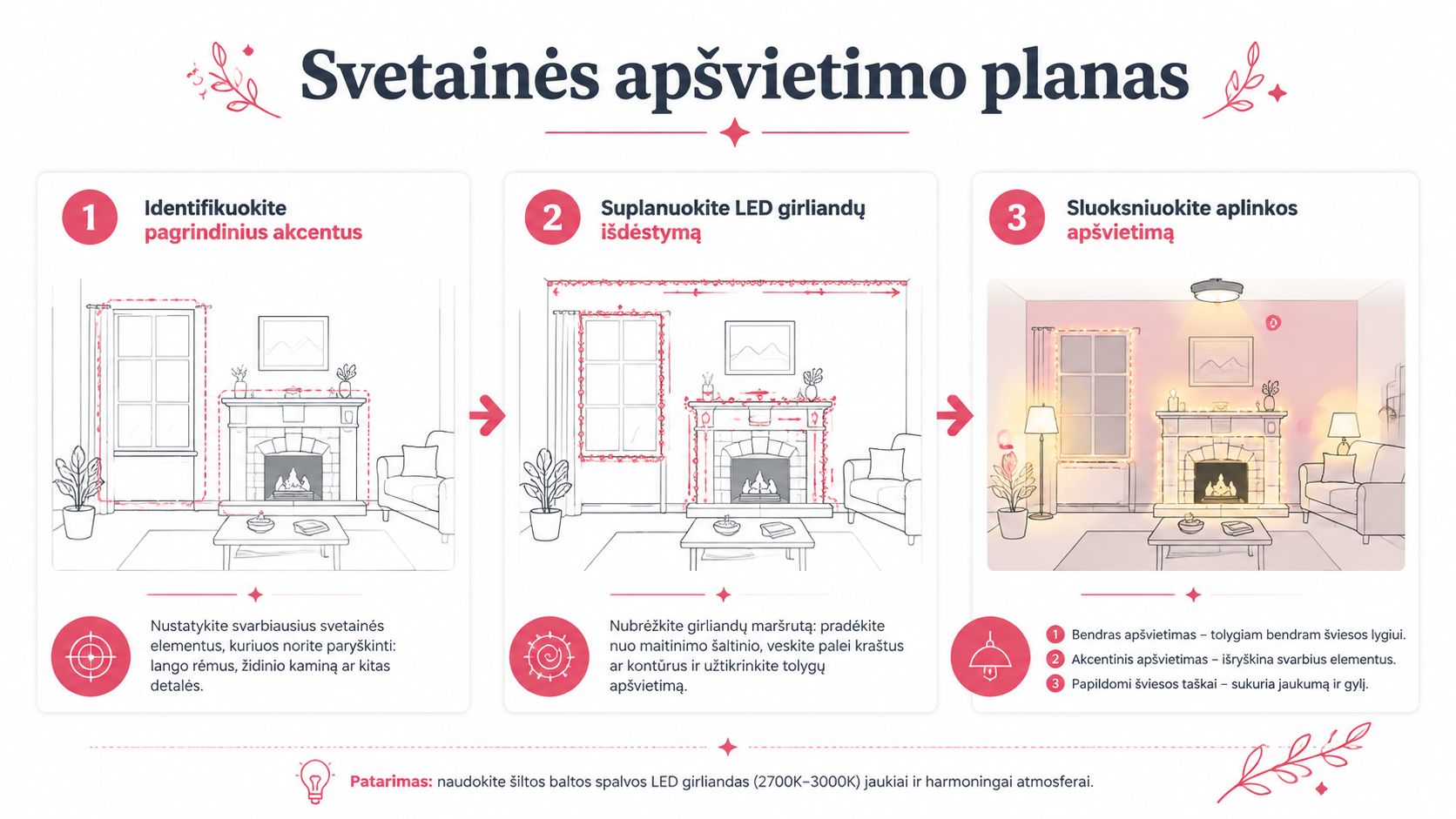
The living room is the place where the festive home really comes together into one picture, so here it is worth controlling the light rather than overcrowding every corner. Background lighting sets the mood, and a non-dazzling glow allows you to talk, watch a film and drink tea without visual fatigue. If this room is tidy, the whole home will look more cohesive.
Where garlands should work and where not
First mark the windows, shelves and the television area. These are natural frames of light, so they do not need extra drama. A garland along a window or a shelf works as an outline, not as the main show.
Planning the lighting without excess emotion is helped by a simple calculation. The average power of an LED garland may be about 7.2 W, and using 5 such garlands for 5 hours a day over a month, the electricity consumption amounts to only 5.4 kWh, or about €1.30 at a tariff of €0.24/kWh. Sensibly arranged LED lighting is not a luxury; it is one of the rare cases where more light does not mean more stress on the bill.
How not to create visual noise
In the living room use only one main light tone. If warm bulbs already hang in one place, do not add flashing, cooler or extremely bright shapes elsewhere. Consistency matters more here than impact, because too many different shapes simply clash with each other.
If you want a more playful environment for children, add to only one corner rather than the whole room. A balloon composition or a smaller garland can work as an accent by the gift area or the play corner, but not across the whole room. This way the living room stays functional and the festivity looks well considered.
How to arrange the zones
The rest zone should be calm; soft light and fewer objects suit it. The gift corner can be brighter, since that is where photos are most often taken. In the play area it is important that decorations do not get in the way or fall down, so choose light, securely fixed solutions.
The Festive.lt garland category is useful when you want to put together light solutions of different lengths and purposes in one place. I would choose only those models that truly fit into your colour scheme, not all those that look nice on their own. In the living room, every object should have a clear reason to be there.
Setting the Christmas Eve and Christmas table
The table is the place where decorations have to work quietly but precisely. If you overdo it, eating becomes uncomfortable and conversations get lost among the objects set around. A good festive table looks rich even when it has few elements.
The base must match the rest of the home
The tablecloth should repeat your chosen colour scheme, not argue with it. If the living room has a warm classic tone, a coldly silver fabric should not appear on the table just because it looks good in a photo. The same rule applies to napkins: they should complement the base, not change the mood.
In the Lithuanian market, long white matte candles are offered that suit exactly those table options where you want height without bulk: product details. I would choose them when I want elegance without overload. They work as a vertical accent that does not take up much space on the table surface.
How to arrange the centre and guest places
The centre needs only one compositional element, a small garland, a sparkling star or a few matching objects. There is no need to build a tall arrangement if you want people to see one another and talk freely. A festive table must be beautiful but not an obstacle.
Small extras, such as name cards or a small gift next to each plate, create more impact than randomly placed objects. They make the table look planned, even though very few elements are really needed. If you use a table runner, it can tie everything into one band and keep the view from falling apart.
What is worth leaving out of the table
Leave out tall, wide decorations and anything that blocks the view during conversation. Leave out bright colours if they do not match the overall home scheme. Leave out excessive shine too, because on the dining table it usually looks cheaper than on a shelf.
The table must keep room for food, hands and eye contact. Everything else is excess.
Saving energy and safety in homes with children
If there are children or pets in the home, choose decorations without romanticising. The first criterion is simplicity, sturdiness and whether the items heat up or break apart at the first touch. Christmas should be cosy, not something that keeps you watching one corner all evening.
Why LED is the smarter choice
LED garlands are a better choice not only because of lower electricity consumption but also because of everyday convenience. They heat up less, so they suit homes where decorations are reachable by small hands or pets’ noses. When lights are switched on for a long time, this difference becomes very practical.
Publicly available data in Lithuania shows that LED light garlands use 80–90% less energy than incandescent alternatives. This is not a minor detail, but simply the smarter decision if you want a calm festive atmosphere without unnecessary costs. If you are choosing one technology for the whole home, choose LED.
How to fix and use them more safely
Fix garlands so that a child cannot pull them down at once. Run the cables along walls or the edges of furniture rather than leaving them hanging in loops. If a decoration has to be below eye level, fix it even more firmly, because that is where curious hands reach first.
Replace candles on the table and in places accessible to children with LED alternatives. Do not overload extension leads, and do not connect too many decorations to one spot. The simpler the system, the fewer chances for mistakes.
Why it is worth buying reusable decorations
In homes with children, disposable sets often wear out faster than you would like. Reusable decorations, sturdier fixings and items that do not break apart pay off more, because you do not have to look for them again the next season. This is not a pretty idea for its own sake; it is simply a tidy household decision.
Choose decorations that last not one evening but the whole season and the following winter. A calmer, nature-inspired aesthetic looks tidy at home, and sturdier, longer-lasting options are less irritating in everyday routine. I would suggest buying less but better quality items, especially where decorations will be within children’s reach.
Shopping list and weekly plan
Now it is worth acting like someone who wants not simply to buy pretty things, but to really decorate the home. Sort the purchases by priority, then plan delivery and installation separately. This will spare you last-day chaos, which often ruins even the best idea.
What to buy first
First order whatever directly determines the whole scheme. These are the garlands, LED bulbs, the tablecloth and the main lanterns. If you have time, add the other basic pieces at once, because they usually decide whether all the later accents will go together.
- Outdoor and indoor garlands. They create the main layer of light.
- Lanterns and lamps. They suit the entrance, the windowsill or the living room.
- Table accessories. Tablecloth, napkins, candles or their LED alternatives.
- Extra accents. Wreath, balloons, stars, small compositions.
When to do what
Hang outdoor garlands first, because fixing them usually takes the most time. Then move on to the living room, where lights need arranging and cables need hiding. The dining room should be the last indoor project, because only then will you see how everything fits together.
A local supplier with a warehouse in Lithuania is a good choice when you do not want to wait and risk pre-holiday delays. Fast dispatch on the same or the next working day is a real advantage here, especially if you are buying at very short notice. That is exactly why it is worth choosing a local option rather than chasing last-minute offers from unknown places.
A weekly plan without improvisation
On Monday order everything that forms the base. On Wednesday install the entrance zone and check that the wreath and garlands hold steady. On Friday tidy the living room, and on Saturday leave the table and small accents, so that on the eve of Christmas Eve only the enjoyment of the result remains.
If you want to decorate your home without unnecessary distraction, choose one scheme and stick to it to the end. Festive.lt has garlands, lanterns, table decor and balloons that are easy to combine into a cohesive home plan. Visit Festive.lt and put together your Christmas decorations list today.
 Table Decorations
 Party Accessories
 Christmas Costumes